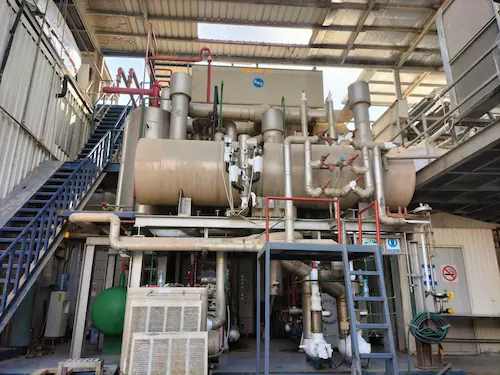
Engineering disclaimer: The values, calculations and examples in this article are educational and reference material based on typical design conditions for an industrial facility in the Eastern Province. They are not a substitute for stamped engineering design or for review by the competent authorities. Refrigerant charge sizing, compressor and evaporator selection, and machinery room, ventilation and detection design must be carried out by a qualified engineer using actual site data and the current editions of ASHRAE 15, IIAR 2, the Saudi Building Code (SBC), and High Commission for Industrial Security (HCIS) and Civil Defence requirements.
What is ammonia as an industrial refrigerant?
Ammonia (NH3), identified in refrigeration as R717, is a natural refrigerant composed of one nitrogen atom and three hydrogen atoms. It entered industrial refrigeration applications in the late 19th century and remains the preferred refrigerant for large food plants, slaughterhouses, ports, ice plants, and heavy cold-chain operations worldwide.
Like fluorinated refrigerants, ammonia operates in a vapor compression cycle: heat absorption in the evaporator, pressure rise through compression, and heat rejection in the condenser. However, its thermodynamic properties give it superior capacity and efficiency in large-scale systems.
Core physical properties of ammonia (R717)
| Property | Value | Engineering implication |
|---|---|---|
| Molecular weight | 17.03 g/mol | Very light refrigerant mass flow |
| Boiling point (1 bar) | -33.3 C | Suitable for chilling and freezing duty |
| Latent heat of vaporization | 1368 kJ/kg at -33C | Substantially higher heat transport per kg |
| COP range | 4.2 - 4.8 | Among the highest practical efficiencies |
| Flammability range in air | 15% - 28% | Managed by proper ventilation and controls |
| Occupational exposure limit | 25 ppm (ACGIH) | Requires calibrated leak detection systems |
| GWP | 0 | Zero global warming contribution |
| ODP | 0 | No ozone depletion impact |
Engineering note: Ammonia's high latent heat means lower refrigerant mass is needed for the same thermal duty, reducing flow requirements and improving system-level efficiency.
Technical and economic advantages of ammonia systems
Engineers choose ammonia in large facilities for cumulative technical and financial reasons, not only for sustainability branding.
1) Superior thermal efficiency
Ammonia outperforms the common synthetic refrigerants on COP. At an evaporating temperature of −25 °C, an optimised ammonia system typically reaches a COP around 4.5 against roughly 2.7–3.3 for R404A or R507 at the same duty. That gap translates directly into a permanently lower electrical input for the same refrigeration effect — the saving is earned every running hour rather than at commissioning, which is why it dominates lifecycle economics on plants that run continuously.
2) Lower refrigerant medium cost
A kilogram of anhydrous ammonia costs on the order of a few Saudi riyals, against roughly SAR 80–400 per kilogram for industrial fluorinated refrigerants. On a large plant holding 2,000 kg of charge, the difference runs to hundreds of thousands of riyals — and it recurs at every major recharge after a repair, not only at first fill. This is also why a leak on an ammonia plant is a safety event rather than a financial one, which reverses the usual maintenance priorities.
3) Strong alignment with environmental regulations
Under the Kigali Amendment and the European F-Gas direction, older high-GWP refrigerants such as R404A are in phase-down. With GWP = 0 and ODP = 0, ammonia sits outside those restrictions entirely, which removes a future compliance and substitution cost that a plant specified today will otherwise carry for its whole service life.
4) Reliable leak detection
Ammonia has a sharp odour that can give early warning at relatively low concentrations — but smell must never be treated as a detection method. Continuous exposure induces olfactory fatigue within minutes: the sensation of smell stops while the concentration keeps climbing, which is exactly the condition under which people stay in a space they should have left. Reliable detection means fixed, calibrated instruments configured to ASHRAE 15 and IIAR 2, with odour as a supplementary cue and never a substitute.
Field insight: On high-load processing plants, a well-designed ammonia retrofit can reduce annual energy cost against a legacy refrigerant system — but only where controls, condenser performance and maintenance discipline are all aligned; any one of the three left unaddressed absorbs most of the gain. The size of the reduction is specific to the plant and is established by metering twelve months before and after the conversion, not by applying a published percentage.
Ammonia versus modern fluorinated refrigerants: practical comparison
There is no single refrigerant that wins every scenario. Selection depends on duty profile, facility size, risk controls, staffing competence, and lifecycle cost priorities.
| Criterion | Ammonia R717 | R448A / R449A | CO2 R744 |
|---|---|---|---|
| GWP | 0 | High relative value | 1 |
| Typical low-temp COP | High | Moderate | Condition-dependent |
| Refrigerant medium cost | Low | Higher | Moderate |
| Hazard profile | Toxic, limited flammability | Lower toxicity, non-flammable | High pressure operation |
| Operating pressure range | Moderate | Moderate-high | High |
| Best fit | Large industrial plants | Small-medium facilities | Advanced transcritical designs |
Critical material rule: Do not use ammonia with copper and copper alloys. Carbon steel and approved compatible materials are required for safe and durable ammonia circuits.
Design fundamentals for industrial ammonia systems
Ammonia system engineering is more rigorous than standard packaged refrigeration, but it follows a clear methodology.
1) Thermal load calculation first
Accurate load breakdown is mandatory: envelope heat gain, product load, personnel and lighting load, infiltration from doors, and process peak conditions.
2) Compressor concept selection
- Reciprocating compressors: practical for medium-duty installations.
- Screw compressors: common for high-capacity industrial plants.
- Centrifugal compressors: suitable for very large centralized systems.
3) Refrigerant feed architecture
- Direct expansion (DX): simpler and lower CAPEX for mid-size networks.
- Liquid overfeed/pumped recirculation: preferred in large multi-evaporator systems.
4) Machinery room requirements
Ammonia machinery rooms are engineered to ASHRAE 15 and IIAR 2 as the technical reference, and to the Saudi Building Code (SBC) plus High Commission for Industrial Security (HCIS) and Civil Defence requirements as the regulatory reference inside the Kingdom.
- Dedicated machinery room with both natural and mechanical ventilation openings.
- Emergency ventilation sized from the ASHRAE 15 airflow equation driven by the refrigerant charge in the room, not by a fixed air-change rate. Sizing to charge rather than room volume is what keeps the dilution rate valid when the same room is later re-piped for a larger system.
- Fixed calibrated detection with staged logic: alarm at 25 ppm, emergency ventilation start at 150 ppm, and evacuation alarm and shutdown at the higher threshold set in the facility design document per IIAR 2.
- Fire-rated doors opening outward, and at least one second emergency exit.
- Manual emergency isolation reachable from outside the hazard zone, and a dump tank able to receive the full ammonia charge.
Safety first: complete practical requirements
Properly designed and competently operated ammonia systems can run safely and reliably for decades. Safety performance depends on engineered controls, procedural discipline, and recurring drills.
Essential PPE
- Self-contained breathing apparatus (SCBA).
- Chemical splash goggles and face shield.
- Chemical-resistant gloves and suit where required.
- Site-specific emergency PPE stations and inspection records.
Emergency response plan (ERP)
- Defined assembly points and evacuation routes.
- 24/7 emergency contacts and escalation matrix.
- Manual and automatic isolation procedures.
- Routine drills and documented competency refresh.
Compliance note: Large-charge ammonia installations require local authority coordination and strict code compliance. Always validate permitting, hazard classification, and operating procedures with qualified engineering and safety teams.
Suggested recurring safety checks
| Frequency | Inspection task | Reference basis |
|---|---|---|
| Daily | Pressure and temperature logging | Operating SOP |
| Weekly | Leak detector verification | Site safety plan |
| Monthly | Safety valve and isolation review | Maintenance protocol |
| Quarterly | Refrigerant quality and contamination check | Engineering QA |
| Annually | Full compliance and integrity audit | Applicable codes and standards |
Safety gap review for an operating ammonia plant: If your system is already running, the practical next step is to compare its current state against ASHRAE 15, IIAR 2, and HCIS and Civil Defence requirements. Initial review scope: a free desk review capped at two office hours covering the detector schedule and alarm thresholds, the ventilation drawing, emergency isolation valve locations, and the refrigerant charge record. Data required: estimated charge quantity, machinery room layout, photos of the control panel and detectors, and the most recent inspection report if available. Limits: the review is desk-based and excludes site visits, pressure testing and compliance certification; it is not a statement of conformity, and an accredited assessment requires a field survey under a separate proposal. Request a safety gap review, or review preventive maintenance contracts and refrigerant leak detection procedures.
Operations and preventive maintenance discipline
High ammonia system performance is sustained only by structured preventive maintenance with measurable KPIs.
Compressor maintenance
Covers oil changes at the manufacturer's stated interval — commonly every 4,000–6,000 running hours — filter inspection, testing of the high and low pressure cutouts, and logging discharge gas temperature, which in Gulf ambient conditions should not be allowed past roughly 135 °C. Discharge temperature is the most informative single reading on an ammonia compressor: it rises before anything else does when the condenser fouls, when the charge falls, or when suction superheat drifts, so trending it against the commissioning baseline buys weeks of warning.
Condenser performance management
In Saudi summer operation, removing calcium and salt deposits from the condenser is decisive: any fouling, or degradation on the airflow or water side, raises condensing pressure and energy use within days. Evaporative condensers are generally preferred on ammonia plants here, since they can hold the condensing temperature roughly 8–12 °C below what a dry air-cooled condenser achieves at the same ambient — a difference that shows up directly in compressor power draw, and that is lost entirely if the water treatment programme is neglected.
Oil return strategy
Oil logging is one of the defining operational challenges of an ammonia plant: compressor oil is not miscible with ammonia and accumulates in the evaporators and the low points of the network, where it coats the heat transfer surface and quietly removes capacity. The answer is designed in, not added later — oil separators, automatic oil return lines, and a scheduled manual drain from the lowest collection points. A plant losing capacity with clean coils and a correct charge is very often a plant holding oil in its evaporators.
From the field: test ammonia purity quarterly using a Draeger or equivalent test kit. A water content above roughly 200 ppm indicates a leak on the water side of the condenser and must be dealt with immediately — dissolved water forms ammonium hydroxide, which attacks the circuit internally and turns a repairable condenser leak into a system-wide corrosion problem.
Key industrial applications in Saudi Arabia
Ammonia systems in Saudi Arabia are concentrated in sectors that need large, continuous refrigeration duty.
1) Seafood and fish freezing plants
Jazan port, Jubail Industrial City and the Dammam ports host dozens of plants running ammonia systems in the 500–3,000 kW refrigeration range. Reaching −40 °C on an IQF line is generally achieved more efficiently with ammonia than with the common synthetic refrigerants, because its high latent heat moves more heat per kilogram circulated — which affects the size of several system components as well as energy use, subject to design and operating conditions.
2) Slaughterhouses and meat processing
Poultry can be chilled within hours according to the plant specification, whereas red-meat carcasses normally require a graded chilling curve reaching roughly 7 °C over about 24 hours, since excessive early chilling risks cold shortening and measurable toughening of the meat. Ammonia suits both duties because its high latent heat sustains large, continuous refrigeration loads with stable suction conditions.
3) Industrial ice and chilled water plants
Ammonia has historically dominated this sector. Ice plants in Dammam, Jubail and Riyadh have used it for decades to produce block ice, flake ice and tube ice, where the duty is continuous, the plant is industrial, and trained staff are already on site — the three conditions under which ammonia is at its most economic.
4) Large refrigerated logistics hubs
Facilities with large floor area and high throughput often benefit from ammonia systems when designed and operated under strict engineering governance.
Frequently asked questions about ammonia refrigeration systems
Ammonia is a natural refrigerant identified as R717 or NH3, used in industrial refrigeration for over 150 years. Under favourable design conditions, and according to compressor manufacturer data, its COP typically falls in the 4.2–4.8 range, which means lower electrical input per ton of refrigeration and a corresponding effect on running cost depending on operating hours and the applicable tariff. Its GWP is 0 and its ODP is 0.
Ammonia is toxic and strongly irritating to the respiratory tract and eyes. The ACGIH occupational exposure limit is 25 ppm TLV-TWA over eight hours and 35 ppm STEL for short-term exposure, while 300 ppm is classified Immediately Dangerous to Life or Health (IDLH) and requires immediate evacuation. Its flammable range in air is approximately 15–28% by volume in enclosed spaces. Risk is therefore managed through fixed calibrated detection, emergency ventilation designed to ASHRAE 15 and IIAR 2, emergency isolation, and trained response protocols. Odour is an additional warning cue, never a detection method: olfactory fatigue can suppress the sensation within minutes while the concentration keeps rising.
Initial CAPEX for an ammonia system is usually 20–35% higher than a comparable Freon system, varying with capacity, machinery room design and safety requirements. Lower refrigerant cost and higher cycle efficiency can shift 15-year total cost of ownership in favour of ammonia on many large projects. The actual outcome is established only by a feasibility study based on project loads, operating hours and the applicable electricity tariff, so no fixed percentage should be generalised across projects.
Ammonia is generally most effective in systems above roughly 100 kW of refrigeration capacity, where the charge is justified by the duty and a dedicated machinery room is already required. For smaller facilities, modern lower-GWP blends such as R448A or R449A are often more practical and carry lighter safety and staffing obligations.
Conclusion: when should you choose ammonia?
If your project aligns with the following, ammonia is often the right choice:
- Cooling demand exceeds 100 kW.
- Industrial environment with controlled risk management.
- Long-term energy optimization is a strategic priority.
- Sustainability and low-GWP compliance are required.
- Qualified technical staffing is available or planned.
For smaller or densely occupied facilities requiring lower complexity, modern low-GWP alternatives remain valid options and should be compared through a full engineering study.
Need an initial engineering review? Send the required refrigeration capacity, operating temperature, estimated charge and the machinery room layout if available. The initial review is free, desk-based and limited to assessing the data provided, outlining the likely system architecture and flagging safety and regulatory gaps. Detailed design, shop drawings and feasibility studies are quoted separately and no performance figure is fixed before site data is confirmed. See also cooling load calculation and maintenance contracts. Contact us now.