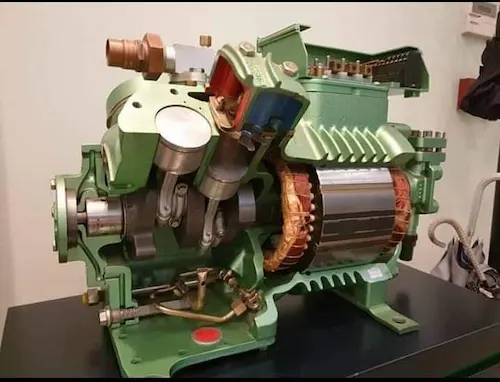
Why we specify Bitzer on some projects
Since Bitzer was founded in Germany in 1934, it has established itself as the most trusted name in industrial refrigeration compressors worldwide. In the Saudi market specifically, Bitzer compressors account for more than 60% of all compressors installed in industrial and commercial refrigeration projects.
The principal reason is not price or marketing — it is these compressors' ability to adapt to the extreme conditions that Saudi Arabia presents: ambient temperatures exceeding 50°C in summer, high coastal humidity, and frequent power interruptions that subject compressors to repeated starting stress. These conditions make a disciplined maintenance programme more important and more urgent than in temperate climates.
Engineering note: Every 5°C rise in condensing temperature increases condensing pressure by 15–20% and raises compressor electricity consumption by 3–4%. Correct maintenance therefore starts with ensuring a clean condenser and efficient ambient cooling.
Bitzer compressor types and industrial applications
Before discussing maintenance, it is essential to understand the mechanical structure of the compressor you are working with, since maintenance requirements differ significantly between the two main types.
A. Semi-hermetic reciprocating compressors
These are the most widely deployed in Saudi Arabia for sound reasons: they can be opened on-site and repaired without being transported to a workshop. Output ranges from 2.2 kW to 110 kW and they are used in medium-to-large cold rooms. The most common series in the Saudi market are 2K, 4H, 6H and 8H. Valves are the primary weak point in these compressors.
B. Semi-hermetic screw compressors
Used in large-scale projects requiring refrigeration capacities above 150 kW, such as large logistics warehouses and industrial freezing systems. The OS.X and CSH series are most frequently installed in our Eastern Province projects. Maintenance here is more complex and demands higher specialisation, particularly for bearing alignment and internal volume ratio adjustment.
| Criterion | Reciprocating | Screw |
|---|---|---|
| Power range | 2.2 – 110 kW | 55 – 500+ kW |
| Major overhaul interval | Every 20,000 operating hours | Every 25,000 operating hours |
| On-site repair capability | Very high | Moderate (specialised equipment needed) |
| Primary weak points | Valves, rings, pistons | Bearings, oil, slide valve |
| Oil change interval | Every 2,000 hours or annually | Every 4,000 hours or annually |
Professional preventive maintenance schedule
Preventive maintenance is the decisive difference between a compressor that runs for twenty years and one that fails in its third. The following schedule is based on Bitzer's own guidelines, adapted from our field experience in the Saudi climate.
| Frequency | Required action | Responsible party |
|---|---|---|
| Weekly | Record operating pressures (suction/discharge), check surface temperature, verify oil level in sight glass, listen for abnormal sounds | Operations technician |
| Monthly | Clean air-cooled condenser coil, inspect electrical cables and connections, measure compressor and fan motor current, check oil filter differential pressure | Maintenance technician |
| Every 3 months | Clean evaporator coils, inspect suction strainer, review controller programme, test motor winding insulation resistance | Maintenance engineer |
| Annually (full PM) | Full oil change, replace oil filter, inspect and service valves, measure cylinder compression pressure, clean motor terminals, test run capacitors | Specialist engineer |
| Every 20,000 hours | Full overhaul: disassemble compressor, inspect pistons and rings, renew valves, inspect crankshaft, measure cylinder wear | Specialist team with genuine Bitzer parts |
⚠️ Saudi climate note: In summer (June – September), we recommend increasing condenser cleaning frequency to every two weeks instead of monthly, due to increased airborne dust and ambient temperature rises that accelerate the degradation of cooling efficiency.
Compressor oil change: complete details
Oil is the lifeblood of the compressor, performing multiple simultaneous functions: lubrication, internal cooling, sealing between piston and cylinder, and corrosion protection. Any error in oil selection or delay in changing it leads inevitably to progressive deterioration that is difficult to diagnose until significant damage has occurred.
Selecting the correct oil by refrigerant type
This is the most common source of error among technicians. The oil is intrinsically linked to the refrigerant in use:
- With R-404A, R-507, R-407C: Use synthetic POE (Polyol Ester) oil — Bitzer BSE 55 or equivalent at ISO VG 46 viscosity is recommended.
- With R-134a: POE also, but at ISO VG 32 viscosity for low-temperature applications.
- With R-717 (ammonia): Mineral or PAO oil that does not mix with the refrigerant; handle with full safety precautions given ammonia's hazard profile.
- With R-290 (propane) or R-600a: Mineral oil at ISO VG 32 viscosity.
🚫 Common and serious mistake: Using mineral oil with HFC refrigerants such as R-404A causes oil accumulation in the evaporator, severely reduces cooling efficiency, and damages the compressor over time. Always confirm the correct oil on the compressor nameplate.
Correct oil change procedure
- Stop the compressor and isolate power, then wait 15 minutes for pressures to stabilise.
- Place a collection vessel below the oil drain valve at the base of the compressor body.
- Open the drain valve slowly and fully drain the old oil. Note the oil colour: dark oil or a burning smell indicates an internal problem requiring investigation.
- Replace the oil filter at every oil change without exception.
- Add fresh oil through the fill port until the level reaches the mid-point of the sight glass. Correct quantities are available in the free Bitzer Software tool.
- Run the compressor for 10 minutes, then stop and recheck the oil level.
Valve inspection and maintenance
Valves are the most wear-prone components in reciprocating compressors. Their function is to prevent gas returning from the discharge side to the suction side. Any leak, even minor, noticeably reduces compressor efficiency and raises electrical consumption without increasing cooling output.
Signs of valve deterioration
- Falling suction pressure alongside rising compressor current — an apparent contradiction that points to leakage.
- Discharge gas temperature consistently above 120°C.
- Compressor runs for extended periods without reaching the required pressure.
- Regular knocking or ticking sounds during operation.
Field valve efficiency test
The simplest field test is the Pump Down test: close the liquid line and let the compressor pump suction pressure down to -0.5 bar, then shut it off suddenly. If suction pressure rises back within one minute, the discharge valves are leaking and require replacement.
✅ Practical advice: In Saudi Arabia's climate, we recommend a valve inspection at least once every two years even in the absence of obvious symptoms, particularly for compressors running more than 16 hours per day.
Most common faults and their root causes
Based on maintenance records from more than two hundred sites we have serviced across the Eastern Province, Riyadh, and Jeddah, the following are the most frequently recurring failures ranked by occurrence rate:
| Fault | Actual root cause | Resolution |
|---|---|---|
| Compressor trips on thermal protection | Dirty condenser or superheat too low due to incorrect expansion valve setting | Clean condenser + re-adjust expansion valve (target 5–8°C superheat) |
| High compressor current | High condensing pressure (dirty condenser), broken valves, or low supply voltage | Measure supply voltage + inspect valves + clean condenser |
| Compressor fails to start | HP/LP cut-out trip or defective run capacitor | Reset + test capacitors + re-calibrate protection switches |
| Severe noise on startup | Liquid slugging due to liquid refrigerant accumulation in the suction chamber | Review expansion valve setting + fit liquid separator if required |
| External oil leak | Damaged front-cover gasket or valve-cover gasket due to excessive heat | Replace genuine gaskets and re-investigate discharge temperature |
🔧 Service-record review for an operating compressor: The schedule above only helps once it is compared against what was actually carried out on your machine. Matching your record to the schedule is what surfaces the overdue items before they become a failure. Initial review scope: a free desk review capped at one office hour, covering running hours against oil and filter change intervals, operating parameters against the manufacturer's published limits, and a priority order for the items that were missed. Data required: compressor model and serial number, running hours, date and grade of the last oil change, refrigerant type, and the most recent discharge pressure and temperature readings. Limits: the review is desk-based and relies on the data you send, excludes any site visit, field measurement, calibration or certification, and issues no guaranteed figure; it does not include opening the compressor, laboratory oil analysis or vibration measurement, and is not an assessment of internal component condition nor a warranty of continued operation. A confirmed diagnosis requires a field survey under a separate proposal. Send your service record for review, or see preventive maintenance contracts, condensing unit maintenance and superheat and subcooling tuning.
Monitoring operating parameters
An experienced engineer does not rely on intuition alone — they record numbers and compare them against reference values. The following parameters should be measured and logged at every maintenance visit:
| Parameter | Typical reference value | Action on deviation |
|---|---|---|
| Suction pressure (R-404A) | 2.0 – 3.5 bar (cold room) | Check expansion valve and liquid line filter-drier |
| Discharge pressure (R-404A) | 13 – 17 bar (Saudi summer) | Clean condenser + check cooling fans |
| Discharge gas temperature | Below 120°C | Raise superheat or inspect valves |
| Oil pressure differential | 1.5 – 3.0 bar above suction pressure | Change oil filter or add oil |
| Compressor current draw | Within ±5% of nameplate value | Measure supply voltage + inspect valves |
| Suction superheat | 5 – 8°C for reciprocating compressors | Re-adjust expansion valve |
Field inspection checklist
This checklist was developed over years of field work to serve as a practical tool our technicians carry on every scheduled maintenance visit.
✅ Daily / weekly checklist
✅ Monthly / quarterly checklist
Conclusions and recommendations
A Bitzer compressor is not immune to failure, but it is engineered to operate at high efficiency for decades — provided one condition is met: regular preventive maintenance driven by real data, not guesswork.
The first recommendation is to document every maintenance activity in a written or digital log that includes all readings, quantities used, and observations. A well-maintained log reveals recurring patterns and can predict a failure months before it occurs.
The second recommendation is to use genuine spare parts exclusively or manufacturer-approved equivalents. Saving a small amount on a substandard part can result in full compressor replacement after one operating season.
The third — and most critical in the Saudi context — is: never neglect condenser cleaning in summer. A fouled condenser in 48°C ambient can destroy a new compressor within three months.
Do you need a specialist Bitzer maintenance team? Elfarida Ice provides comprehensive periodic maintenance contracts covering the Eastern Province, Riyadh, and Jeddah. Contact us for a free quote.
Related articles
Need a system health assessment?
Our engineering team can audit your compressor station and issue a practical maintenance action plan.
Contact usEngineering disclaimer: The schedules, values and service intervals in this guide are general educational reference material assuming typical duty. The governing reference for any compressor is the current edition of the manufacturer's model manual and the warranty terms attached to it; any conflict is resolved in their favour. Work on a pressurised circuit or an electrical panel requires a qualified technician, lockout-tagout isolation and appropriate personal protective equipment.