In most emergency call-outs for industrial chiller and freezer plants, the root cause isn't the compressor or the evaporator — it's the electrical panel: a loose terminal that heated up gradually, a contactor whose contacts wore down from constant cycling, or moisture that got past a failed gasket and damaged a control board. The panel houses every protection, control, and metering function in the system, so any fault there ripples through the whole plant immediately, and sometimes puts staff safety at risk.
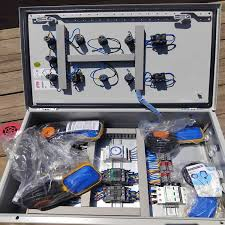
On a 360-ton chiller, the panel typically includes a main circuit breaker (MCCB), a contactor for each compressor stage, thermal overload relays, a phase-failure/voltage monitoring relay, an electronic controller or PLC, a control transformer stepping down to 24V for auxiliary circuits, and often a VFD plus a power-factor correction capacitor bank. Each of these has a design life and an ideal operating envelope that drifts without regular attention.
The 8-Point Inspection Checklist
Tighten and Thermally Scan All Terminations
Repeated thermal cycling gradually loosens terminal screws, and a loose connection creates localized resistance that heats up until it burns insulation or triggers an arc flash. A quarterly thermal-imaging scan catches hot spots before they become failures, particularly on panels feeding loads above 50A.
Frequency: quarterlyRun an Insulation Resistance (Megger) Test
A megger test between conductors and earth should read above roughly 1 megohm per 1000V of operating voltage; a lower reading signals moisture ingress, conductive dust, or cable aging. This test matters most in coastal areas like Dammam and Khobar, where high humidity accelerates degradation inside panels that aren't fully sealed.
Frequency: annualInspect Contactors and Contact Points
Every compressor on/off cycle draws a small arc across the contactor's contact points, gradually pitting the surface and raising resistance. Multi-stage refrigeration control cycles contactors far more often than typical loads, so visual inspection every six months is warranted, with replacement at the first sign of burning or visible pitting rather than waiting for a full failure.
Frequency: semi-annualCalibrate Thermal Overload Protection
The overload relay must be set to the actual full-load current stamped on the compressor motor's nameplate, not an estimate. Setting it too high effectively disables protection and risks winding burnout; setting it too low causes nuisance tripping. Recheck the setting immediately after any motor rewind or replacement.
Frequency: quarterlyCheck the Electronic Controller or PLC
Apply manufacturer firmware updates when available, review the event log for accumulated unresolved alarms, and test the backup RTC battery — if it fails, controller settings can be lost on the next power interruption. These checks protect the site-specific control programming invested in each project.
Frequency: semi-annualVerify the Enclosure's IP Rating and Integrity
Panels mounted outdoors alongside chiller units should maintain at least IP54 protection (IP65 is preferable in dusty or sandy environments), with door gaskets, breather vents, and cable glands checked regularly to keep out dust, moisture, and insects — a common cause of failures in sensitive electronic circuits in desert climates.
Frequency: quarterlyTest Grounding and Surge Protection
Earth resistance should read below roughly 5 ohms under most engineering standards, measured annually with a dedicated earth resistance tester. Also verify the surge protection device (SPD), which shields the controller from voltage spikes caused by lightning or grid fluctuations — common during the rainy season in the Eastern Province.
Frequency: annualClean the Interior and Confirm Cooling Airflow
Accumulated conductive dust inside the panel reduces the clearance between different voltage points and raises the risk of a tracking fault. Clean with dry compressed air and a non-conductive brush with the panel de-energized, and confirm the ventilation fan or panel cooling unit is working — VFDs generate significant heat that needs active dissipation to avoid nuisance thermal trips.
Frequency: semi-annualPreventive Maintenance Schedule at a Glance
| Item | Frequency | Action | Engineering Note |
|---|---|---|---|
| Terminals and screws | Quarterly | Thermal scan + torque check | Use a calibrated torque wrench, not guesswork |
| Contactors | Semi-annual | Visual inspection of contact points | Replace at the first sign of burning |
| Thermal overload relays | Quarterly | Match setting to motor nameplate | Recheck after any motor rewind |
| Controller / PLC | Semi-annual | Review alarm log and RTC battery | Keep a backup of the program |
| Insulation resistance | Annual | Megger test on each power circuit | Reference: above 1 megohm/kV |
| Grounding and SPD | Annual | Measure earth resistance, test SPD | Maximum acceptable: 5 ohms |
| Enclosure (IP rating) | Quarterly | Check gaskets and cable entries | Minimum IP54 for outdoor installation |
Most Common Electrical Faults and Root Causes
Most electrical panel failures in industrial refrigeration trace back to four recurring causes: loose terminations that worsen silently for months before showing a visible symptom, moisture entering through failed gaskets or unsealed openings, contact wear on contactors in applications with frequent cycling, and excess heat from poor ventilation, especially in panels housing VFDs or power-factor correction capacitors. Early diagnosis through thermal imaging and routine visual inspection prevents these four causes from turning into a full plant shutdown or a safety incident.
Documentation: The Foundation of Effective Preventive Management
A written maintenance log for each panel — recording every inspection date, measured readings, and replaced parts — turns maintenance from reactive firefighting into proactive, data-driven management. Comparing insulation or earth-resistance readings across years reveals a degradation trend before it reaches a dangerous point, something a single isolated inspection can't show.
Need an engineering inspection for your control panel?
Elfarida Ice performs thermal scanning and full insulation and grounding testing on electrical panels, backed by documented engineering standards.
Request an Engineering Inspection