Chillers serving large buildings, factories, and institutional facilities - up to 360 tons of cooling capacity - are not equipment you maintain only when something breaks. Every additional run hour without a scheduled inspection brings the compressor and condenser closer to a sudden failure that can cost tens of thousands of riyals and halt operations for days. Most major failures do not happen overnight; they build up slowly through tube fouling, winding insulation breakdown, or oil contamination, and all of these are detectable long before they turn into an actual failure.
A sound preventive maintenance program is not built around a single schedule. It is four inspection tiers running at different frequencies, each one catching a different kind of degradation. This is the schedule we apply to client units from 30 to 360 tons, whether air-cooled or water-cooled.
The Four-Tier Inspection Program
Weekly Check - Operating Readings
A weekly field round records suction and discharge pressure, compressor oil pressure differential (normally 25 - 40 psi depending on the compressor type), the approach temperature between refrigerant and condenser or evaporator water (typically a 1 - 2°C design value; anything above 3°C is an early sign of tube fouling), motor current against rated FLA, and the sight glass moisture indicator color - green means dry refrigerant, yellow means moisture is present and the filter drier needs checking. Any unusual noise or vibration is logged immediately, not left for the next scheduled visit.
Priority: daily operationalMonthly Check - Cleaning and Electrical Verification
Clean condenser water strainers, verify cooling tower water treatment dosing (scale inhibitor and biocide) along with conductivity against the setpoint defined by the water treatment programme for that site - a figure around 2,500 µS/cm is a common blowdown trigger on open cooling towers, but the correct limit depends on makeup water quality, cycles of concentration and the chemical regime, so it is taken from the treatment specification rather than from a general rule, inspect the electrical panel and tighten terminal connections, check contactors for pitting or burn marks, inspect VFD cooling fans and filters, and - on low-pressure centrifugal machines with a purge unit - confirm the discharged refrigerant volume stays within normal range; excessive purge discharge signals an air leak into the system that needs deeper investigation.
Priority: monthly preventiveQuarterly Check - Technical Analysis
Lab analysis of a compressor oil sample: acid number should stay below 0.05 mg KOH/g, and moisture content below 50 - 100 ppm depending on refrigerant type. Bearing vibration measurement per ISO 20816 (which supersedes ISO 10816); the acceptance band depends on the machine class and mounting, and on many chiller drivelines an RMS velocity below about 4.5 mm/s falls in the acceptable range - always read the limit from the class table applicable to that machine, and trend the reading against its own commissioning baseline rather than judging a single absolute value. Motor winding insulation resistance measurement with a megger (minimum acceptable value is 1 megaohm per kV plus 1 megaohm). Calibration of pressure and temperature sensors against a certified reference. Review of the expansion valve superheat setting, and functional testing of flow switches and protection cutouts.
Priority: analyticalAnnual Check - Major Overhaul
Performed during the low-load season and includes: eddy current testing (ECT) of condenser and evaporator tubes to detect wall thinning or pitting before an actual leak develops, a full refrigerant charge analysis per AHRI 700 (acidity, moisture, non-condensables, particulates), replacement of filter driers, an infrared thermographic survey of the full electrical panel and VFD units to catch hot spots before they become failures, cooling tower fill servicing and fan gearbox oil change, alignment and mechanical seal checks on chilled and condenser water pumps, and a full functional test of every protection and alarm point. This inspection also compares cumulative run hours against the manufacturer's major overhaul recommendation, typically between 40,000 and 60,000 run hours depending on compressor type.
Priority: comprehensive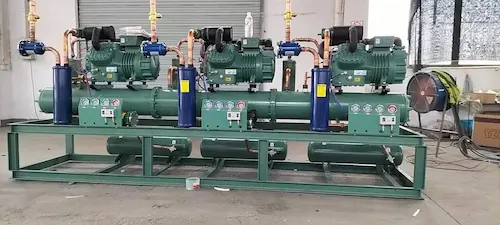
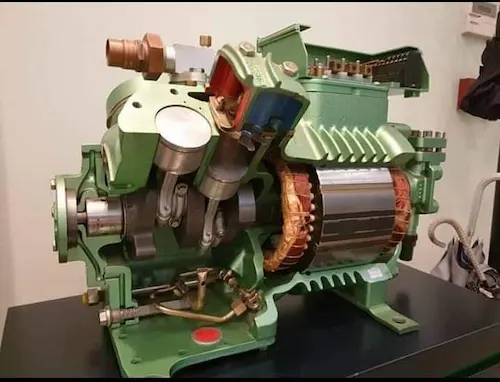
Medium and large chillers (above 100 tons) commonly use a multiple compressor bank instead of a single large compressor. This design spreads the load and reduces actual run hours per compressor, but it does not remove the need for inspection - every compressor in the bank needs the same weekly and monthly checks independently, because one failed compressor in the bank increases the load on the rest and accelerates their wear.
Preventive Contract vs. Waiting for a Breakdown
| Item | Without a Preventive Contract | With a Preventive Maintenance Contract |
|---|---|---|
| Cost of periodic inspection | Apparently zero | Predefined annual contract |
| Probability of sudden shutdown | High, usually during peak summer load | Significantly reduced |
| Emergency compressor replacement cost | SAR 25,000 - 80,000 + downtime | Rarely reaches this stage |
| Expected service life | 10 - 12 years | 18 - 20 years |
| Documented maintenance record | Usually unavailable | Available, supports claims and warranty |
Monitoring and Documentation: The Chiller Log
A consistent paper or digital log is what turns maintenance from reactive into proactive. The core items to record are:
1. Weekly suction and discharge pressure at roughly the same time of day. 2. Weekly approach temperature at the condenser and evaporator, compared against the commissioning baseline. 3. Quarterly oil analysis and vibration results, keeping prior reports for trend comparison rather than relying on a single instantaneous reading.
Common Mistakes That Undermine a Maintenance Program
Even with a written schedule in place, we repeatedly see field mistakes that erase the benefit of the program. The first is relying on a visual check without logging actual numbers - "the unit looks fine" is an impression, not an engineering observation, and it will not catch a slow performance decline. The second is postponing oil analysis because the sample "looks clean" to the naked eye, even though acidity and moisture are invisible in their early stages. The third is skipping eddy current tube testing on the assumption that no leak means no problem - that is precisely the point of preventive testing: it catches wall thinning before it becomes an actual leak.
The fourth mistake, and arguably the most costly in facilities running more than one chiller, is applying the same schedule to every unit regardless of actual run hours. A unit running 24 hours a day in a factory cannot be inspected at the same frequency as a standby unit that only runs seasonally. Tying inspection frequency to cumulative run hours - not just the calendar - is what keeps the program both accurate and cost-effective.
Want a documented preventive maintenance program for your chiller?
Elfarida Ice builds a maintenance schedule tailored to your unit's capacity and cooling type (air or water), with documented periodic reports.
Request a Maintenance Proposal