In Gulf climate conditions, refrigeration systems can run near peak duty for long periods. The good news is that much of the excess power consumption is avoidable through better maintenance and correct settings.
These ten measures are ordered by implementation simplicity and expected impact. Some can be applied immediately with near-zero cost.
Ten Energy-Saving Measures, in Priority Order
Clean Condensers Monthly, Not Seasonally
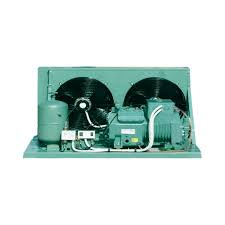
Fouled condenser fins are a leading cause of higher power draw. As a field approximation, each 1 °C rise in condensing temperature corresponds to roughly 2–3% more power drawn by the compressor, and a blocked coil can raise condensing temperature by 5–10 °C. In Dammam's summer, where ambient is already near the design limit, that penalty is paid every running hour. Note the scope: the percentage applies to compressor draw rather than to the whole bill, and it varies with refrigerant, evaporating temperature and compressor type, so the real gain is confirmed by metering before and after a clean under comparable conditions.
Potential saving: 15% - 30%Reduce Defrost Cycles to the Necessary Minimum
Every defrost cycle injects heat into the evaporator and raises room temperature, which then has to be pulled back down. Many systems run four cycles a day where fewer would do in cooler months. Start from the manufacturer's recommendation and adjust by observation; the usual band for freezer rooms is 2–4 cycles per day. Do not reduce the count without a weekly visual check of the coil through the first month — frost building on the fins, or the room failing to reach its setpoint, means the cycles have been cut too far, and a starved coil costs far more than the defrost it saved.
Potential saving: 8% - 15%Add VFD Control for Compressors and Condenser Fans
Variable-speed operation matches capacity to the actual load instead of cycling on and off. A compressor does draw a high current for a few seconds at start, which raises peak demand and stresses components — but the real saving from a VFD comes from capacity matching across the load curve, not from avoiding those starts. Expect something in the range of 10–25% depending on how variable your load actually is; a plant that runs at close to full load around the clock will see far less. Read the specific model bulletin before installation: the permitted frequency window differs between families, a minimum ramp time applies, VFD must not be combined with other capacity-control methods at the same time, and running below the approved minimum degrades oil return and voids the warranty.
Potential saving: 10% - 25%Review Setpoint Strategy Against Real Product Need
Running colder than the product requires is expensive: every degree
below the necessary storage condition is paid for continuously.
Align setpoints with the product specification rather than with
habit or with a number inherited from a previous tenant.
The limit runs the other way, and it is not negotiable: raising a
chilled meat room above 4 °C, or a freezer room above
−18 °C, in search of an electricity saving exposes you
to food-safety and regulatory consequences far larger than the
energy involved, and can put the whole consignment at risk of
rejection. Set the operating points to Saudi Food and Drug
Authority (SFDA) requirements and the product specification
first, then look for savings in efficiency rather than in
temperature.
Repair Door Gaskets and Envelope Insulation Defects
Air leakage and insulation degradation add continuous thermal load. Regular gasket inspection and wall condition checks reduce hidden infiltration losses.
Potential saving: 5% - 15%Shade the Condensing Unit from Direct Solar Radiation
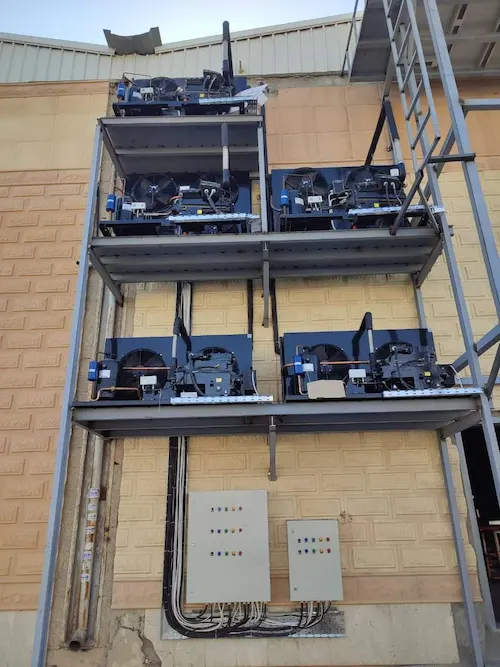
Properly designed shading can lower effective thermal stress on the condensing side and improve system efficiency if airflow is not restricted.
Potential saving: 5% - 12%Fix the Floating Head Pressure Setpoint
Many plants hold condensing pressure at a fixed high value inherited from commissioning, because the expansion valve was sized for it. Allowing condensing pressure to float down with ambient — within the minimum the valve and the oil return actually need — recovers efficiency on every cool night and shoulder month of the year. The prerequisite is an expansion valve able to work at the lower pressure difference, which is why this measure usually pairs with an electronic valve rather than standing alone.
Potential saving: 5% - 15%Correct the Superheat Setting Before Buying Anything
A superheat setting that has drifted high starves the evaporator and pushes the compressor to run longer for the same duty; set too low, it risks liquid return. Neither shows on a temperature display — the room still reaches setpoint, it just takes more energy to get there. Measuring and correcting superheat and subcooling costs a technician visit rather than capital expenditure, which is why it belongs before any equipment purchase on the priority list.
Potential saving: 5% - 12%Install PVC Strip Curtains or Air Curtains on High-Traffic Doors
Frequent door opening drives major warm-air ingress. Physical air barriers reduce exchange load and support better compressor duty stability.
Potential saving: 8% - 18%Schedule Loading and High Thermal Activity Strategically
Shift high-thermal-load operations — bulk intake, extended door
openings, wash-down — away from the hottest hours where the
process allows. Condensing pressure tracks ambient, so the same
work costs more at two in the afternoon than at six in the
morning.
One caution on tariffs: Saudi commercial and industrial
electricity is billed on consumption brackets rather than on
time-of-use windows, so there is generally no cheap night rate to
shift load into. The saving here comes from lower ambient
temperature at the condenser, not from a tariff window — check
the structure that actually applies to your account before
planning around it.
ROI Snapshot with Typical Numbers
| Action | Estimated Cost | Monthly Saving | Payback |
|---|---|---|---|
| Monthly condenser cleaning | SAR 200 - 500/month | SAR 1,000 - 3,000 | Immediate |
| Defrost optimization | Zero (parameter tuning) | SAR 500 - 1,500 | Immediate |
| Compressor VFD installation | SAR 8,000 - 25,000 | SAR 2,000 - 6,000 | 8 - 18 months |
| Setpoint correction | Zero (parameter tuning) | SAR 800 - 2,500 | Immediate |
| Door gasket replacement | SAR 300 - 800/door | SAR 400 - 1,200 | 1 - 3 months |
| Condenser shading structure | SAR 500 - 1,500 | SAR 300 - 800 | 2 - 5 months |
| PVC strip curtains | SAR 200 - 600/door | SAR 600 - 1,800 | 1 - 2 months |
Monitoring: The Non-Negotiable Foundation
You cannot improve what you do not measure. Core tracking includes:
1. Weekly electricity meter trend. 2. Weekly condensing pressure at consistent conditions. 3. Daily room temperature stability record before operation start.
Want to reduce your cold-storage electricity bill?
Elfarida Ice can perform an energy audit and provide measurable, site-specific savings recommendations.
Request Energy Audit