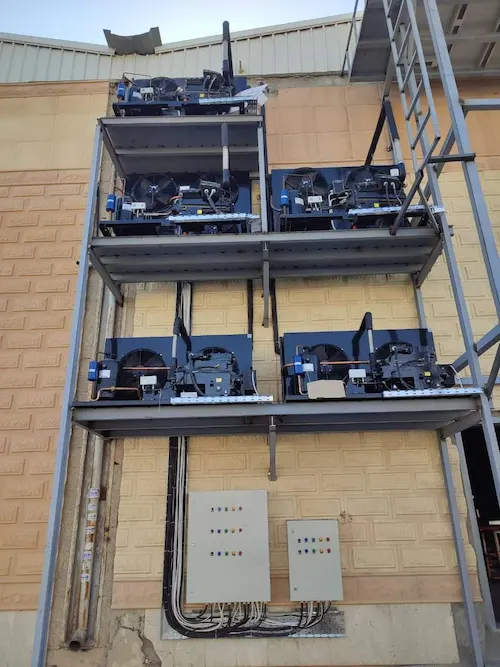
A common question in commercial refrigeration projects is whether to choose a scroll compressor or a reciprocating compressor. There is no universal answer. Each technology has a best-fit operating envelope and use case.
How a Scroll Compressor Works
A scroll compressor uses two interleaved spirals, one fixed and one orbiting. Refrigerant gas is compressed progressively toward the center. This near-continuous compression profile reduces pulsation, vibration, and acoustic footprint.
How a Reciprocating Compressor Works
A reciprocating compressor uses piston movement within a cylinder for stepwise compression. The architecture is mechanically familiar, robust in higher pressure ratios, and often preferred for lower evaporating temperature duty.
Comprehensive Comparison: Scroll vs Reciprocating
| Criterion | Scroll | Reciprocating |
|---|---|---|
| Energy Efficiency (EER) | Higher by around 10-15% | Lower at part load |
| Noise and Vibration | Very low | Higher pulsation and vibration |
| Capacity Range | About 1.5 to 12 TR per single compressor, and up to roughly 20 TR in tandem (ZPD) units | 1 to 150+ TR in multi-compressor racks |
| Pressure Ratio Flexibility | Wide; low-temperature models (ZF/ZS) operate at 10:1 and above within the published envelope | Higher, up to about 10:1 |
| Evaporating Temperature Limits | Medium-temperature models (ZR/ZB) down to about -25 C; low-temperature models (ZF/ZS) operate considerably lower, per each model's published operating envelope | Suitable down to -40 C and below |
| Moving Parts Count | Lower, generally higher reliability | Higher, needs more periodic maintenance |
| Initial Cost | Slightly higher | Lower |
| Five-Year Operating Cost | Lower due to efficiency | Higher in many duty cycles |
| Field Repairability | Usually replaced as sealed unit | Wider field repair options |
| VFD Operation | Excellent on dedicated variable-speed models; standard models run a narrower window (roughly 45-60 Hz) | Discus models carry a wider window (roughly 25-60 Hz). In both cases read the model bulletin: minimum ramp time applies, VFD must not be combined with other capacity control, and running below the approved minimum degrades oil return and voids the warranty |
When to Choose Scroll
Scroll compressors are typically the better option in the following situations:
- ->Retail and commercial outlets: low noise and low vibration matter in occupied spaces.
- ->VFD-driven systems: strong part-load behavior and smooth modulation.
- ->Small to medium cold rooms: common range from 1 to 10 TR above deep-freeze duty.
- ->Lifecycle-cost-driven projects: higher efficiency often offsets initial cost over time.
When to Choose Reciprocating
- ->Deep freezing duty: below -30 C where high pressure ratio tolerance is required.
- ->Large-capacity systems: applications above typical single-scroll range.
- ->Field service priority: better access to component-level maintenance in many markets.
- ->Broader industrial refrigerant cases: depending on model family and application constraints.
Copeland Product Families: Typical Options
| Series | Type | Capacity | Typical Use |
|---|---|---|---|
| ZR / ZB | Scroll | 1.5 - 10 TR | Commercial refrigeration |
| ZF / ZS | Scroll (low temp) | 2 - 12 TR | Medium freezing duty |
| ZPD | Tandem scroll | 8 - 20 TR | Medium warehouses |
| 2D / 4D / 6D | Reciprocating | 1 - 20 TR | Cooling and freezing |
| 4MKT / 4MTL | Reciprocating (deep freeze) | 3 - 15 TR | Industrial freezing |
Not Sure Which Compressor Fits Your Site?
Elfarida Ice engineers can assess your load profile and recommend the correct compressor architecture.
Get Consultation