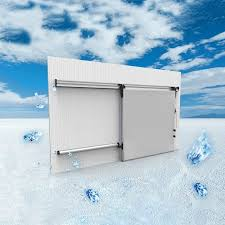
Many facility owners treat the cold-room door as a simple opening closure. In reality, the door is often the largest thermal-exchange point in the envelope. Every unnecessary opening under hot ambient conditions adds load, operating cost, and product risk.
Cold Room Door Types
1. Sliding Insulated Door
The most common option in industrial cold rooms. It moves on an overhead rail without requiring swing clearance. Typical insulation core is polyurethane in the 80 to 120 mm range. Suitable for medium traffic operation.
2. High-Speed Spiral Door
Designed for high-cycle environments. Fast opening and closing significantly reduce air exchange and thermal losses. Capital cost is higher, but ROI improves strongly when daily opening frequency is high.
3. Hinged Insulated Door
A simple and cost-effective solution for small, low-traffic rooms. It requires clearance for swing movement and is not recommended for wide openings or intense logistics traffic.
4. PVC Strip Curtain
Not a full substitute for a door, but an effective supplemental barrier. Commonly paired with sliding doors in loading zones to reduce warm-air infiltration during frequent transfer activity.
5. Air Curtain
Uses directed air flow to limit air exchange across an opening. It is suitable for very large openings and near-continuous loading operation where full door closure is operationally impractical.
Comprehensive Comparison Table
| Door Type | Best For | Openings/Day | Installation Cost | Service Life |
|---|---|---|---|---|
| Sliding Insulated | Industrial cold and freezer rooms | 30 - 80 | Medium | 10 - 15 years |
| High-Speed Spiral | Active logistics warehouses | 80 - 300+ | High | 15 - 20 years |
| Hinged Insulated | Small rooms up to 20 m2 | 5 - 30 | Low | 8 - 12 years |
| PVC Strip Curtain | Supplement to doors | Unlimited | Very Low | 2 - 3 years |
| Air Curtain | Large openings 3 m and above | Continuous | Medium | 8 - 12 years |
Insulation Thickness: The Highest-Impact Energy Variable
Door U-value represents thermal resistance performance. Lower U-value means lower heat transfer and better efficiency. Typical engineering recommendation is:
Electrical Door Frame Heating
Freezer applications typically require frame heating to prevent ice lock and ensure reliable opening. Heating cable operation should be verified periodically, especially in sub-zero duty applications.
Preventive Maintenance for Cold Room Doors
-
Inspect gasket condition every 6 months for cracks, gaps, or loss of compression.
-
Lubricate rails and sliding rollers every 3 months with low-temperature compatible grease.
-
Verify full auto-closure performance and ensure no partial-open states remain.
-
Test frame heating continuity in freezer applications on a planned monthly routine.
-
Confirm no ice layer develops at threshold level, as this usually indicates humid-air ingress.
Need the right cold-room door for your facility?
We provide complete door supply, installation, and technical commissioning support.
Contact Us Now