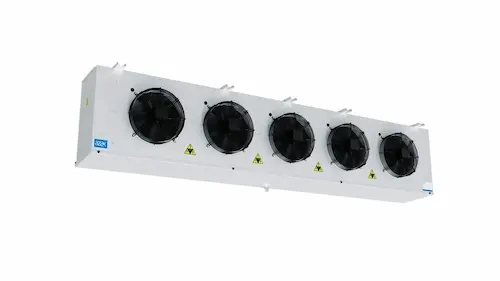
In food cold-storage logistics, wrong evaporator selection can create temperature non-uniformity and product risk. Friga-Bohn units are often selected because of their well-engineered air distribution characteristics.
This article explains with practical criteria why many refrigeration engineers prefer Friga-Bohn and how to size the unit correctly.
Air Throw: The Most Critical Parameter
Air throw is the effective distance cold airflow can travel while maintaining required temperature conditions. Large rooms need sufficient throw to avoid warm zones far from the evaporator.
Typical design target at the end of throw is low but effective air velocity that avoids dehydration and minimizes local cold spots.
Main Friga-Bohn Series and Applications
| Series | Temperature Range | Main Application | Defrost Type |
|---|---|---|---|
| LU / LU-V | 0 C to +10 C | Fruit and vegetable storage | Air off-cycle |
| GHN | -18 C to -5 C | Meat and fish freezing | Electric / hot gas |
| RAE / RAV | -25 C to -15 C | Long-term frozen storage | Electric |
| MHID | -45 C to -30 C | Blast freezing and IQF lines | Hot gas |
| GBC | 0 C to +5 C | Dairy and cheese storage | Air / hot gas |
Understanding TD and Delta-T in Selection
TD (or ΔT1) is the difference between the room air entering the coil and the refrigerant evaporating temperature inside it. It is the single number that makes two evaporator quotations comparable — or makes them meaningless when it differs between them.
Capacity scales roughly in proportion to TD, so a unit rated 20 kW at TD = 10 K delivers in the region of 10 kW at TD = 5 K, not 12 kW. This is the most expensive misreading in evaporator selection: a supplier quoting at a high TD shows a larger capacity for a smaller and cheaper unit, and the shortfall only appears once the room cannot hold its setpoint. Always take the exact figure from the manufacturer's correction factors rather than scaling by eye.
Choosing the TD is a humidity decision as much as a capacity one. A low TD of 4–6 K keeps the coil closer to room temperature, so less moisture condenses out and produce stays turgid — which is why fresh fruit, vegetables and unwrapped meat rooms are designed that way, at the cost of a physically larger coil. A higher TD of 7–10 K buys a smaller, cheaper unit and is perfectly acceptable for packaged and frozen goods, where dehydration is not a concern.
TD is the difference between room air temperature and refrigerant evaporating temperature. Lower TD generally supports higher room humidity, which is essential for many fresh-food applications.
Some Friga-Bohn families are optimized for lower TD operation, helping maintain product-friendly humidity targets.
Defrost Strategy: Cooling vs Freezing Rooms
Defrost type is selected by room temperature, and getting it wrong is the most common cause of an evaporator that ices progressively until it stops absorbing heat at all.
- Hot gas defrost diverts discharge gas through the coil. It is the fastest and most energy-efficient option for freezing rooms, and it puts the heat where it is needed without adding electrical load, but it requires additional valves and piping and a system designed for it from the start.
- Electric defrost uses resistance elements in the coil block. It is simpler to install and to retrofit, which is why it dominates smaller freezer rooms, but every watt it consumes is paid for twice — once at the element and once by the compressor that must remove that heat from the room afterwards.
- Off-cycle (air) defrost simply stops the refrigerant and lets room air melt the frost with the fans running. It is free, but it only works where room temperature stays comfortably above freezing — practically, at +2 °C and above. Specifying it for a room that dips below that is how a coil ends up permanently blocked.
Whatever the type, the drain line decides whether the defrost actually clears. Fit a P-trap outside the room to stop cold air drawing back up the line, slope the drain at roughly 1–2% away from the unit, and fit heater tape on any drain that passes through a space that can fall below 0 °C. Meltwater that refreezes in the drain returns to the tray and builds an ice block that no defrost cycle can shift.
In freezing rooms, frost accumulation reduces heat-transfer efficiency over time. Friga-Bohn supports multiple defrost approaches depending on operating profile.
1. Hot Gas Defrost
Fast and efficient, often preferred where downtime must be minimized and process continuity is critical.
2. Electric Defrost
Simple to implement for small and medium rooms, but requires careful cycle management to avoid extra thermal disturbance.
3. Air Off-Cycle Defrost
Applicable mostly in higher-temperature rooms where light frost can be cleared without active heating.
Unit Selection by Product Category
| Product Type | Required Temperature | Recommended Series | Target TD | Room Humidity |
|---|---|---|---|---|
| Fresh meat | 0 C to 2 C | LU-V | 5 C | 85% - 90% |
| Fruits and vegetables | 2 C to 8 C | LU-V | 5 - 6 C | 90% - 95% |
| Dairy and cheese | 2 C to 6 C | GBC | 6 - 7 C | 80% - 88% |
| Frozen meat and fish | -18 C | GHN | 5 C | - |
| Long-term freezing | -22 C to -25 C | RAE | 4 - 5 C | - |
Installation and Orientation Best Practices
Selection decides what the unit can do; installation decides what it actually does. The points below are the ones that most often separate a coil performing to its data sheet from one that never reaches it.
Even a correctly selected unit underperforms with poor installation. Key practices include:
-
Place evaporators to support full-room airflow coverage.
-
Respect clearance from ceiling and structural obstructions.
-
Ensure proper drain pan slope and reliable defrost-water disposal.
-
Avoid placement directly above high-infiltration door zones.
-
For low-temperature rooms, protect drain lines against freezing.
Periodic Maintenance for Friga-Bohn Evaporators
| Task | Frequency | Priority |
|---|---|---|
| Verify complete defrost cycle performance | Weekly | Critical |
| Check defrost water drainage from pan | Weekly | Critical |
| Clean fan blades from dust and frost deposits | Monthly | Important |
| Measure fan speed and electrical current | Monthly | Important |
| Clean coil fins with low-pressure method | Every 6 months | Important |
| Inspect drain-line heating in low-temp rooms | Annually | Routine |
Need help selecting the right evaporator for your warehouse?
Elfarida Ice can review your thermal load and recommend the correct unit for your application.
Contact Us Now