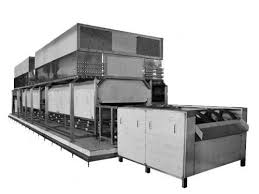
What Is IQF and How Does It Work?
IQF stands for Individual Quick Freezing. It means freezing every piece of food product independently and rapidly, so that pieces never clump together or form a frozen block. The result: individually separated shrimp you can pour by the handful, free-flowing fish fillets, and peas you can measure without defrosting.
IQF operates through three integrated principles:
- High heat-transfer rate: Refrigerated air at −35°C to −45°C is forced over and under the product at velocities of 4–6 m/s, maximizing the convective heat transfer coefficient (h ≥ 50 W/m²·K).
- Full surface exposure: Products rest on a perforated or wire mesh belt that allows air to pass from below, partially lifting each piece (partial fluidization) and exposing its entire surface to the cold airstream.
- Precise residence time control: Belt speed is calibrated so every piece exits the tunnel only after its thermal center reaches −18°C or below — the internationally mandated standard for complete freezing.
💡 Core concept: The key differentiator of IQF is not just speed — it is preventing clumping during freezing. This demands a specific engineering design of belt, fan, and thermal chamber; not merely lowering the temperature.
Ice Crystal Physics: The Secret Behind IQF Quality
To understand why IQF preserves product quality, we need a brief excursion into biophysics. Every food cell contains intracellular fluid and extracellular fluid. When freezing, the speed of passage through the critical zone (−1°C to −5°C) determines the size of ice crystals that form:
The Critical Freezing Zone
Between −1°C and −5°C, approximately 80% of free water in food converts to ice. In this range, slow freezing (over 60 minutes) produces large extracellular ice crystals that draw water out of cells by osmosis, causing cell membranes to collapse and rupture. Upon thawing, the result is high drip loss, spongy texture, and watery flavor.
In IQF, each piece passes through the critical zone in under 30 minutes (often under 10 minutes for small items), forming tiny intracellular ice crystals that cause negligible structural damage.
| Freezing Method | Critical Zone Transit Time | Ice Crystal Size | Drip Loss (Thaw) | Sensory Quality |
|---|---|---|---|---|
| Slow / Traditional | 4–24 hours | Large: 200–500 µm | 8–15% | Soft texture, watery flavor |
| Conventional Blast Freezer | 60–180 minutes | Medium: 50–200 µm | 4–8% | Good, below IQF |
| Standard IQF Tunnel | 8–30 minutes | Small: 10–50 µm | 1–3% | Excellent — near-fresh |
| Cryogenic IQF (LN₂) | 1–5 minutes | Micro: <10 µm | 0.5–1.5% | Exceptional — premium products |
✅ Economic implication: Reducing drip loss from 10% to 2% on a 2 ton/hour production line saves 160 kg/hour of sellable product. At SAR 30/kg for frozen fish, that is SAR 4,800/hour of recovered product revenue — directly adding to the bottom line.
Components of an Industrial IQF System
A complete IQF system consists of four integrated subsystems. An engineer must understand each to make sound design decisions:
1. Freezing Tunnel
The sealed metallic chamber through which the product travels. Constructed from stainless steel (SS304 or SS316L for corrosion resistance and food compliance). Standard tunnels range from 5 to 25 meters in length depending on capacity. Wall insulation uses polyurethane sandwich panels, typically 150–200 mm thick.
2. Refrigeration System
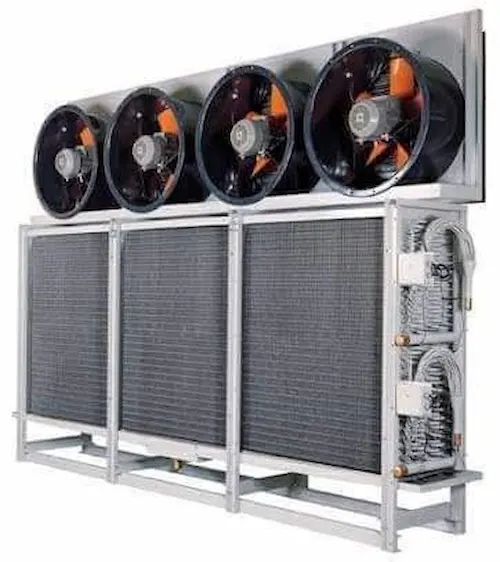
The thermal heart of the system. IQF tunnels operate at evaporating temperatures of −40°C to −45°C, requiring either two-stage reciprocating/screw compressors or low-temperature refrigerants such as R507A or R744 (transcritical CO₂). Ammonia (R717) remains optimal for large capacities (>200 kW) due to its superior thermodynamic efficiency at low temperatures.
3. Air Distribution System
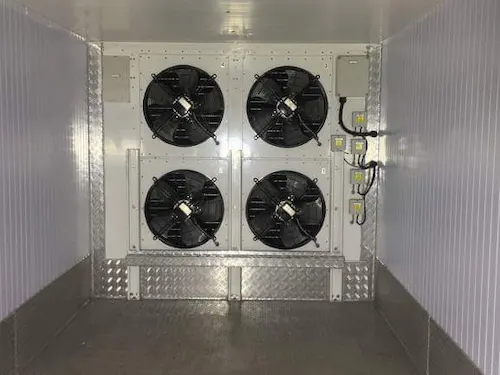
The fan array and duct network is what distinguishes an IQF tunnel from an ordinary blast freezer. Axial fans with EC (electronically commutated) motors are mounted directly above the evaporators. Duct design must achieve airflow uniformity ≥ 85% across the full belt width — ensuring center pieces freeze at the same rate as edge pieces.
4. Conveyor System
The belt is the most mechanically sensitive element. Manufactured from stainless steel wire or food-grade plastics (POM or UHMW-PE). Key requirements for a high-performance IQF belt:
- Perforated mesh allowing through-belt air penetration
- Non-stick surface to prevent product adhesion
- Rated for continuous operation at −50°C without embrittlement
- CIP (Clean-In-Place) compatible for food hygiene compliance
- Resistance to cleaning chemicals and lubricants
Types of IQF Tunnels and How to Choose
There is no single IQF tunnel type that suits every product and plant. Understanding the four main types enables the engineer to select the right tool for the job:
1. Linear / Straight Tunnel
The simplest and most common design. A straight conveyor belt runs from tunnel entrance to exit. Ideal for shrimp, fish fillets, and poultry pieces. Requires significant floor length (10–30 m). Capacity range: 500 kg/h to 5 tonnes/h.
2. Spiral IQF Freezer
The belt climbs in helical loops inside a cylindrical tower, multiplying the effective freezing path length within a compact footprint. Best solution when floor area is limited but throughput is high. Cost is 40–60% higher than linear, but production density per square meter is 3× greater. Preferred for bakery items, poultry, and pizza toppings.
3. Fluidized Bed IQF
Cold air is blown upward with sufficient force to lift and suspend product above the belt (fluidization). Achieves the fastest freezing rates because air contacts 360° of every piece. Limited to small, uniformly-shaped products: peas, sweet corn, blueberries, diced vegetables. Not suitable for large or irregular pieces.
4. Double-Belt IQF
Two parallel belts moving at different speeds with a freezing chamber sandwiched between them. Used for delicate soft products that could deform under their own weight (dough, filled products, delicate pastries). More mechanically complex but preserves product geometry precisely.
| Type | Best Applications | Floor Space | Relative Cost | Freezing Rate |
|---|---|---|---|---|
| Linear | Fish, shrimp, portioned poultry | High (8–30 m length) | 1× (reference) | Fast |
| Spiral | Bakery, poultry, pizza | Very low | 1.5–1.8× | Fast |
| Fluidized Bed | Peas, corn, berries, diced veg | Medium | 1.2–1.5× | Very fast |
| Double-Belt | Dough, filled products | Medium | 1.8–2.2× | Fast |
Engineering Design Parameters
Correct engineering design is the difference between a profitable IQF line and one plagued by under-capacity and high operating costs. The following parameters are essential:
Thermal Load Calculation
The total refrigeration load on an IQF tunnel comprises:
- Product load: Energy to reduce product temperature from inlet temperature to −18°C, including sensible heat above freezing point + latent heat of fusion + sensible heat below freezing point.
- Transmission load: Heat ingress through walls, floor, and ceiling: Q = U × A × ΔT.
- Equipment load: Fan motors, belt drive motors, lighting ≈ 3–5% of product load in well-insulated tunnels.
- Infiltration + safety factor: Add 10–15% to the total for door openings and leakage.
Residence Time Formula
Empirical rule (fish & poultry):
Residence time (min) ≈ C × d²
where d = half the product thickness in cm, C = airflow
constant:
• At −35°C and 5 m/s: C ≈ 3.5–4.0 for fish
• At −40°C and 6 m/s: C ≈ 2.8–3.2 for fish
Example: 20 mm thick fish fillet (d = 1 cm) at −40°C →
residence time = 2.8–3.2 minutes
Design Parameters by Product Type
| Product | Piece Thickness | Inlet Temp. | Air Temp. | Target Residence Time | Loading Density (kg/m²) |
|---|---|---|---|---|---|
| Shrimp (21/25 count) | 12–16 mm | 4°C – 10°C | −40°C | 6–10 minutes | 8–12 |
| Fish fillet | 15–25 mm | 2°C – 5°C | −38°C | 10–18 minutes | 10–15 |
| Chicken breast portions | 20–35 mm | 4°C – 8°C | −40°C | 14–25 minutes | 12–18 |
| Green peas | 7–12 mm | 10°C – 20°C | −35°C | 4–7 minutes | 15–25 |
| Whole strawberries | 20–35 mm | 8°C – 15°C | −38°C | 12–20 minutes | 10–14 |
Thermal Validation Protocol
Before commercial production, HACCP and BRC require a documented thermal validation study proving that the coldest point of the largest piece in each batch reaches −18°C within the set residence time. Requirements include:
- Calibrated temperature probes embedded in product centers
- Continuous data logging via SCADA or data loggers
- Three consecutive successful validation runs
- Records retained for a minimum of 5 years
Industrial Applications in Saudi Arabia
Saudi Arabia is experiencing significant growth in IQF adoption, driven by Vision 2030's focus on food security, domestic production, and export diversification.
1. Fish and Seafood Processing
Saudi Arabia imports over 350,000 tonnes of seafood annually, making it one of the world's largest seafood markets. Major freezing facilities at Jubail Industrial City, Jeddah Islamic Port, and Yanbu operate IQF lines with capacities of 2–10 tonnes/hour. Primary products: raw IQF shrimp, fish fillets, squid rings, and crustaceans.
2. Poultry and Meat Processing
As large poultry processors expand in Riyadh, Al-Qassim and Taif, IQF has become the strategic choice for freezing portioned cuts (thighs, wings, breast strips). IQF enables precise weight-based selling without ice clumps, meeting the stringent requirements of modern retail chains and QSR customers.
3. Vegetable and Fruit Freezing
Growth in domestic vegetable farming in central and northern Saudi Arabia has fueled demand for IQF vegetables. Fluidized bed lines for green peas, sweet corn, and diced peppers achieve high throughput at low per-unit operating costs.
4. Semi-Finished Food Components
IQF is the only viable technology for freezing ready-meal components: cheese cubes, mushroom sauce portions, calamari rings, chopped herbs, and pizza toppings. These products cannot be frozen in bulk and later separated.
✅ Elfarida Ice case study: In 2024 we engineered and commissioned an IQF line for a seafood processing plant in Jubail Industrial City — 3 tonne/hour capacity using a two-stage ammonia system with an 18-meter linear tunnel. Drip loss dropped from 9% (legacy line) to 2.1%, adding over SAR 2 million/year in recoverable product revenue.
IQF vs Other Freezing Technologies
IQF is not always the optimal choice. Here is an objective comparison against the main industrial freezing alternatives:
| Criterion | IQF Tunnel | Blast Freezer | Plate Freezer | Contact Freezer |
|---|---|---|---|---|
| Best products | Small–medium discrete pieces | Large products / full batches | Rectangular block fish | Full cartons/cases |
| Freezing speed | Very fast (8–30 min) | Moderate (1–6 hrs) | Fast for blocks (30–90 min) | Slow (6–24 hrs) |
| Product quality | Excellent — micro crystals | Good | Good for block fish | Acceptable |
| Drip loss (thaw) | 1–3% | 4–10% | 2–5% | 6–12% |
| Product flexibility | Very high | Medium | Low (specific products) | Low |
| Energy consumption | High (fans + refrigeration) | Medium | Low | Low |
| Capital cost | High | Medium | Low–Medium | Low |
⚠️ When NOT to choose IQF: If your product is sold as complete frozen blocks or cases with no need for individual separation, a Plate Freezer or Blast Freezer delivers better efficiency at lower cost. IQF justifies its premium investment only when the market pays a meaningful price premium for individually frozen product.
❄️ Scope review before requesting IQF quotations: Differences between tunnel quotations usually come from differing assumptions rather than differing quality: residence time, air velocity and the assumed evaporating temperature. Fixing the assumptions before you request quotations is what makes the comparison meaningful. Initial review scope: a free desk review capped at two office hours, converting target throughput into an indicative load range, estimating residence time from product thickness and shape, identifying the most suitable tunnel type (linear, spiral or fluidised bed) with the area and infrastructure required, and drafting the assumptions every supplier should quote against. Data required: product type, dimensions and pack format, target throughput in tonnes per hour, entry and exit temperatures, available area and height, preferred refrigerant, and available electrical supply. Limits: the review is desk-based and relies on the data you send, excludes any site visit, field measurement, calibration or certification, and issues no guaranteed figure; it excludes detailed tunnel calculations, final equipment selection and any accredited financial feasibility study, and carries no commitment to a residence time, a drip-loss percentage or a return on investment. Request a line scope review, and see blast versus conventional freezing, ammonia refrigeration systems and maintenance contracts.
Operation and Preventive Maintenance
Peak IQF tunnel performance is only sustained through disciplined maintenance. Neglect threatens not only product quality but also food safety certifications and brand reputation.
Defrost Management
Ice accumulation on evaporators is the primary operational challenge in IQF tunnels. Standard defrost protocols include:
- Hot gas defrost: Most common in large tunnels. High-pressure discharge gas is redirected through a reverse circuit to the evaporator. Full cycle: 20–40 minutes.
- Water defrost: Warm water (40°C) sprayed on evaporators. Fast (10–20 min) but requires sanitary drainage and rigorous hygiene control.
- Electric defrost: Simple control logic but higher energy consumption. Preferred for small tunnels.
Preventive Maintenance Schedule
| Frequency | Task | Responsible Party | Reference Standard |
|---|---|---|---|
| Daily | Log temperature/pressure readings, visual belt inspection | Line operator | Internal SOP + HACCP |
| Weekly | Belt cleaning, ice and residue removal | Sanitation team | GMP / BRC |
| Weekly | Belt tension and tracking alignment check | Maintenance engineer | Manufacturer manual |
| Monthly | Belt and fan bearing lubrication, safety device tests | Maintenance engineer | ISO 22000 |
| Quarterly | Full insulation inspection, full-load belt performance test | Specialist maintenance crew | ASHRAE 15 |
| Annual | Refrigerant circuit inspection, pressure test, thermal re-validation | Certified external engineer | EN 378 / IIAR |
🚨 Food safety alert: Neglecting weekly belt cleaning allows biofilm development. Listeria monocytogenes can survive and grow at temperatures as low as −2°C. A contaminated belt can cross-contaminate entire production batches, triggering costly product recalls and potential loss of food safety certifications.
International Standards and Certifications
IQF-frozen products destined for export or major retail chains must comply with an interlocking framework of international standards:
Food Safety Standards
- HACCP: Identifies Critical Control Points in the production line. The thermal center of the product at tunnel exit (CCP) is one of the most critical CCPs in an IQF system.
- ISO 22000:2018: International food safety management standard. Requires documented Operational Prerequisite Programs (OPRPs) for temperature control.
- BRC Global Standard Food Safety Issue 9: Required for export to the UK and EU. Mandates documented thermal validation for every IQF line and every product.
- SQF Food Safety Code: Required for US and Canadian market access.
- SFDA (Saudi Food and Drug Authority): Saudi regulatory authority for food facility registration. Updated 2024 regulations require documented temperature monitoring and compliance records for all freezing operations.
Refrigeration Engineering Standards
- ASHRAE Standard 15-2022: Safety code for mechanical refrigeration — ventilation, warning signs, and leak detectors.
- EN 378:2021: European standard for safety and environmental requirements for refrigerating systems and heat pumps.
- IEC 60204-1: Electrical safety for industrial machinery including IQF tunnel drives and controls.
💡 Export tip: If you are targeting EU seafood export, you need an EC Establishment Number from the European Commission in addition to BRC or IFS certification. This requires a documented thermal validation study for every product on every IQF line — not just a one-time audit.
Frequently Asked Questions About IQF Technology
Conventional freezing is slow (hours to days), forming large extracellular ice crystals (200–500 µm) that rupture cell walls and cause 8–15% drip loss upon thawing. IQF passes each piece through the critical zone (−1°C to −5°C) in under 30 minutes using −35°C to −45°C high-velocity airflow, generating micro-crystals that preserve cell integrity — resulting in only 1–3% drip loss and near-fresh texture and flavor.
IQF excels with individually portioned products: seafood (shrimp, fish fillets, squid rings), poultry parts, meat cubes and strips, vegetables (peas, sweet corn, diced peppers, broccoli florets), fruits (strawberries, blueberries), and bakery items (croissants, dough portions). The essential requirement is that the product consists of discrete, free-flowing pieces.
Use the empirical formula: residence time (min) ≈ C × d², where d is half the product thickness in cm and C is an airflow constant (≈2.8–3.2 at −40°C and 6 m/s for fish). A 20 mm thick fillet (d = 1 cm) needs roughly 3 minutes. All parameters must be validated by a formal thermal validation study with calibrated probes before commercial production begins.
A complete 1 tonne/hour IQF system costs SAR 1.5–4 million depending on type and manufacturer. ROI is typically achieved in 2–5 years, driven by: reduced drip loss (recovering 7–10% product weight), premium pricing (IQF products command 20–40% price premium), export market eligibility, and reduced rework. A 3 tonne/hour seafood line saving 7% drip loss at SAR 30/kg generates over SAR 1.5M/year in additional revenue.
Daily: temperature/pressure logging and visual belt inspection. Weekly: belt deep-cleaning and ice removal (biofilm prevention — Listeria survives at −2°C). Belt tension/alignment check. Monthly: fan and belt bearing lubrication, safety device testing. Quarterly: insulation inspection, full-load belt performance test. Annual: refrigerant circuit inspection, pressure test, and thermal re-validation by a certified engineer.
Conclusion: When Is IQF the Right Decision?
IQF is not just a freezing machine — it is a strategic positioning decision that reshapes your product's market value. Investment is justified when:
- Buyers pay a clear price premium for individually frozen product
- You target export markets requiring BRC, HACCP, or EU Establishment certification
- Your product cannot tolerate high drip loss without losing significant commercial value (seafood, shrimp, poultry)
- Production throughput exceeds 500 kg/hour (below this threshold, a blast freezer may offer better economics)
- You need operational flexibility to freeze diverse products on the same line
✅ Need a feasibility study for an IQF system? Elfarida Ice's engineering team is ready to prepare a free technical study covering: thermal load calculations, tunnel type comparison, CAPEX estimate, and projected ROI for your specific project. Contact us today.
Engineering disclaimer: The design parameters, capacities and case figures in this guide are educational reference material assuming typical products and line configurations. They are not a substitute for a stamped engineering design or for a validation study specific to your line within the facility's approved HACCP system. Tunnel sizing, residence time and operating temperatures must be established by a qualified engineer from actual product data and the requirements of the Saudi Food and Drug Authority (SFDA) and the destination market.