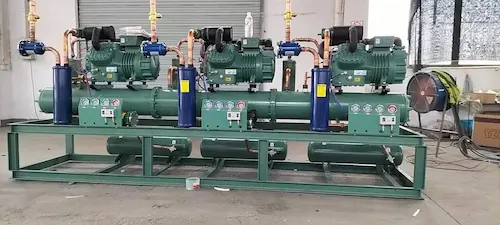
In large industrial projects — multi-zone logistics warehouses, food packing plants, or major food-retail distribution centers — a single condensing unit rarely covers the total thermal load, and installing several fully independent units is often neither economically nor operationally optimal. This is where a compressor rack system earns its place: several compressors mounted on a shared frame, tied to a common suction manifold and a common discharge manifold, running under one central controller that sequences operation based on actual load.
This guide walks through how rack systems work, their core components, and the design and maintenance considerations we apply on Elfarida Ice cold and freezer storage projects of every scale.
What Is a Rack System, and Why Use One?
Instead of installing one condensing unit sized for the full load, a rack system distributes total required capacity across several compressors — typically two to six — of matched or staggered sizes, mounted on one frame with a shared suction and discharge line and one or more parallel condensers. The core idea is splitting the total capacity across multiple smaller units rather than relying on one oversized machine.
This split lets the system run only the number of compressors that matches the actual load at any given moment, instead of running one large unit at full output even during low-demand periods — the single biggest source of the energy advantage rack systems hold over traditional standalone units.
Core Components of a Rack System
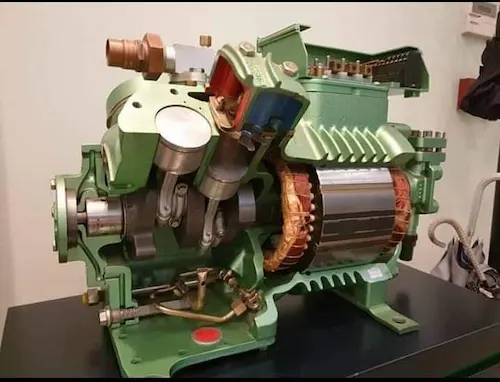
The Compressor Bank
Typically designed with one or two VFD-driven "lead" compressors for fine part-load control, plus fixed-speed "lag" compressors that stage in progressively as demand rises. This arrangement protects compressors from short cycling, which shortens service life significantly.
Common Oil Separator
Because compressors share one discharge line, a high-efficiency central oil separator is required to prevent oil migration out of the system, alongside an oil equalization line that keeps crankcase oil levels balanced across compressors — the most common failure point in poorly maintained rack systems.
Central Rack Controller
A single controller (such as Danfoss AK-PC or an equivalent) monitors suction pressure and automatically decides how many compressors should run, while also managing lead-lag rotation to distribute run hours evenly across the bank and extend combined service life.
Individual Isolation Valves
Each compressor is fitted with dedicated suction and discharge valves that allow it to be fully isolated from the network for service or replacement without shutting down the rest of the system — one of the rack architecture's most valuable practical advantages.
Floating Head Pressure Control
One of the standout advantages of modern rack systems is enabling a floating head pressure strategy — letting condensing pressure drop automatically as ambient temperature falls, rather than holding it at a fixed high setpoint year-round. In Saudi Arabia, where ambient conditions swing from around 45°C in summer to below 15°C on winter nights, correctly tuned floating head control captures a meaningful energy gain without compromising expansion valve performance.
Rack Systems vs. Standalone Units: A Practical Comparison
| Criterion | Multiple Standalone Units | Central Rack System |
|---|---|---|
| Failure redundancy | Requires a full separate standby unit | N+1 built into the same rack, no extra footprint |
| Part-load matching | Poor — frequent on/off cycling | Precise via staged compressor sequencing |
| Ease of maintenance | Full line shutdown required for service | Isolate one compressor, system stays online |
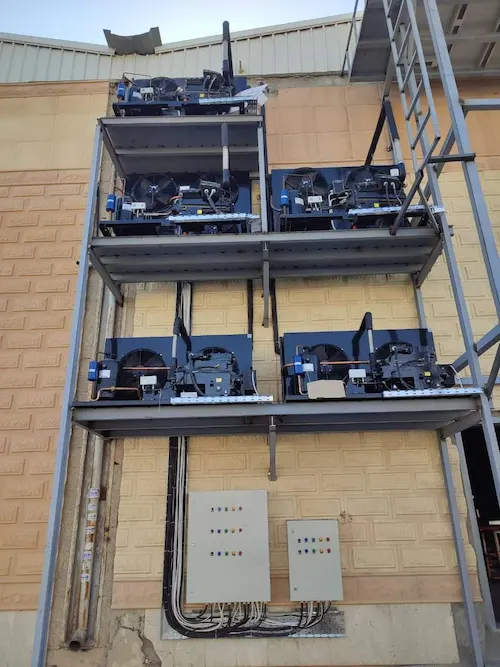
| Installation footprint | Larger — scattered units | Smaller — centralized layout |
| Upfront cost | Lower for small projects | Better economics for large, multi-zone loads |
Best-Fit Applications for Rack Systems
Rack systems shine in large logistics warehouses that need to serve several rooms at different temperatures from one plant — for instance a +2°C chill room and a -18°C freezer room fed by the same rack through separate expansion lines. They are equally well suited to poultry and meat packing plants where thermal load swings sharply between shifts, and to food distribution centers running continuous loading and unloading around the clock.
Maintaining Rack Systems: Points You Cannot Skip
Routine maintenance on a rack system differs from standalone unit maintenance in several important ways. First, check oil level balance across all compressor crankcases weekly — any noticeable divergence points to a problem in the equalization line or the central oil separator. Second, review the compressor rotation log to confirm the controller is distributing run hours evenly rather than continuously loading one compressor. Third, periodically test each individual isolation valve to confirm tight shutoff before it is ever needed in an actual emergency.
Conclusion
A multi-compressor rack system is not merely an alternative to standalone units — it is an engineering investment that rebalances reliability, energy efficiency, and long-term operability. Choosing the right compressor count, the right control strategy, and a maintenance program that respects the rack's specific failure modes are the three factors that determine whether a project succeeds or carries hidden long-term costs.
Planning a large or multi-temperature refrigeration project?
Elfarida Ice designs rack systems engineered precisely to your actual load and continuous-operation requirements.
Request an Engineering Consultation